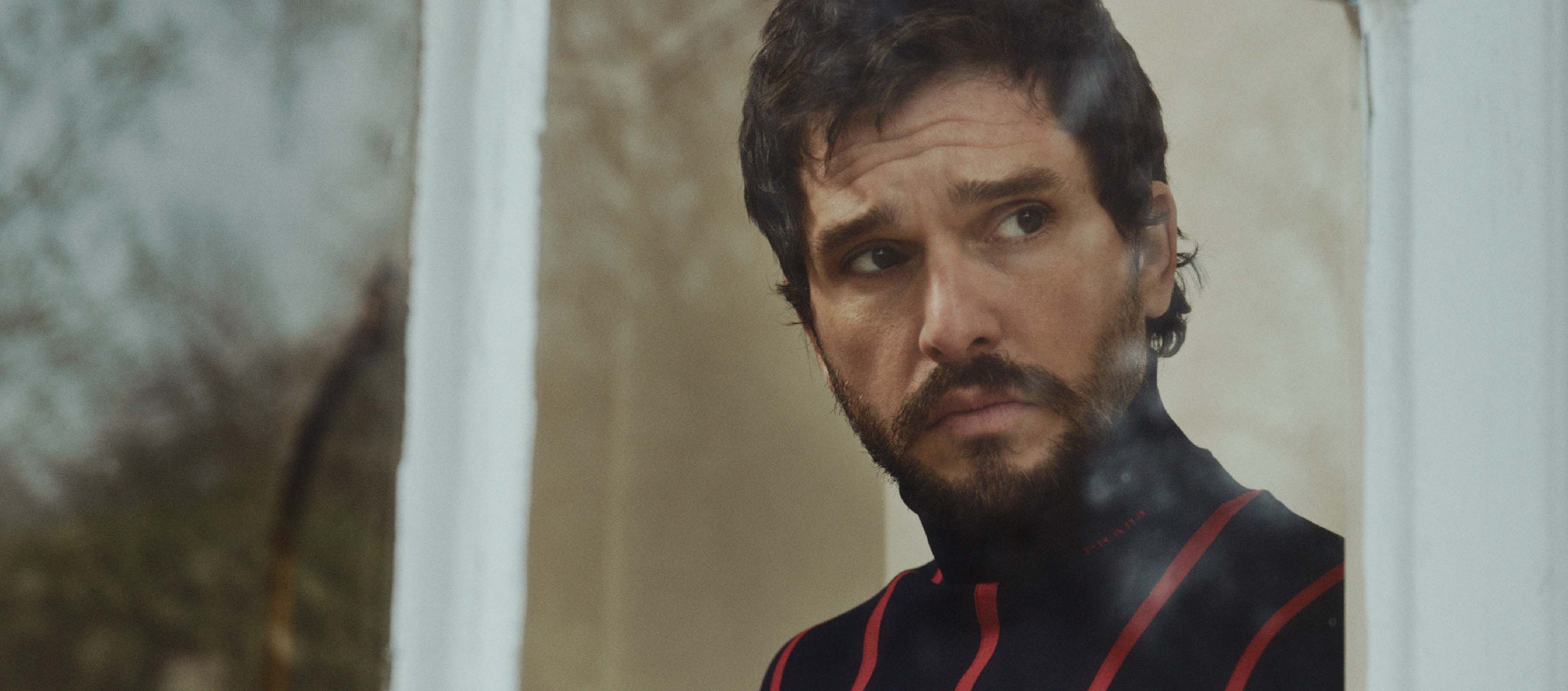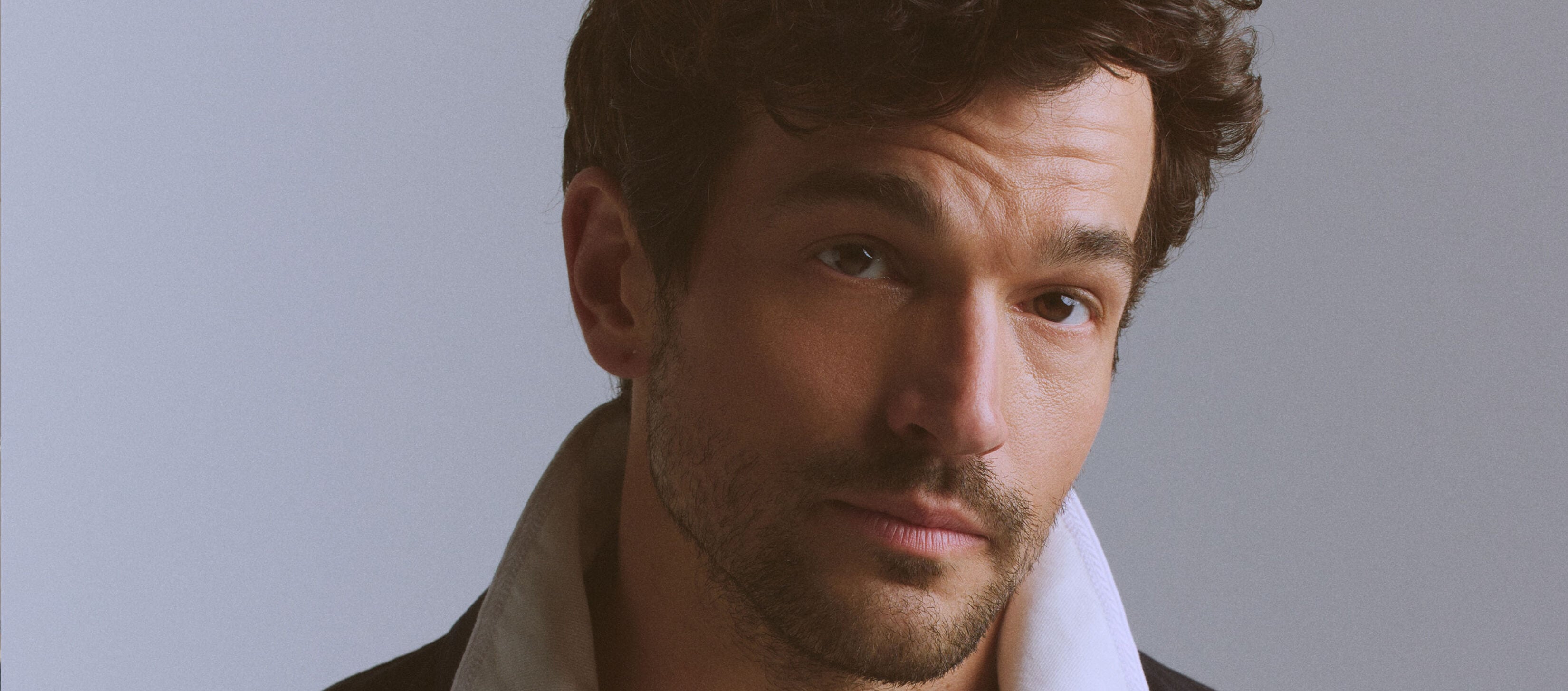


You’re told, quite plainly, that in The Duffer Brothers’ eerie new series Something Very Bad Is Going to Happen, something very bad is, indeed, on its way – but don’t let the warning deter you. As Jeff Wilbusch steps into the role of Jules Cunningham, he sits down with Man About Town to unpack Netflix’s latest unnerving, high-tension horror.
Prepare to be unsettled (in the best way) with The Duffer Brothers’ new Netflix series Something Very Bad Is Going to Happen. The series doesn’t really announce its horror, but it absolutely lets it seep in; slow and insidious, caressing your spine like a cool chill. Before anything is revealed, before the narrative sharpens its edges, there’s a feeling that, well, something isn’t quite right. It lives in the eerie silences, the stretched-out in-betweens that hold for just a beat too long, quietly probing what it means to sit with discomfort – to sense that something is wrong, even when you can’t yet name it.
At the centre of that tension is actor Jeff Wilbusch, who steps into the role of Jules Cunningham with a performance that is both controlled and unnerving. Best known for his breakout turn as Moishe Lefkovitch in Unorthodox, Wilbusch has carved out a space for himself in stories that interrogate identity, interiority, and the unspoken forces that shape us. With SVBIGTH, he leans fully into the ambiguity of Jules, a character who resists easy categorisation, existing in a tight tension somewhere between protector, perpetrator, and something entirely unknowable.
Jules is not written – or played – as your conventional antagonist. Instead, Jeff approaches him from the inside out. He grounds his character in survival instincts, all of which stemmed from emotional repression, left over from a childhood that continues to haunt him in ways both visible and obscured, and mostly inescapable. It’s this refusal to play the typical menace that makes his performance compelling. What surfaces instead is a man in constant negotiation with himself – someone trying, and often failing, to maintain control over a world that feels like it’s slipping just out of reach.
The series itself, created by writer and director Haley Z. Boston, uses horror as a lens through which to explore something more intimate: the fragility of relationships, the weight of generational trauma, and the quiet, creeping fear of choosing wrong – whether that’s in romantic relationships, family, or the versions of ourselves we commit to becoming. Within that framework, Jeff’s portrayal of Jules becomes a kind of emotional barometer, where his internal fractures mirror the wider disintegration of the Cunningham family dynamic.
Sitting down with Man About Town, Wilbusch speaks on inhabiting the show’s ambiguity, the emotional residue of the role, and why the most unsettling stories are often the ones that hit closest to home.
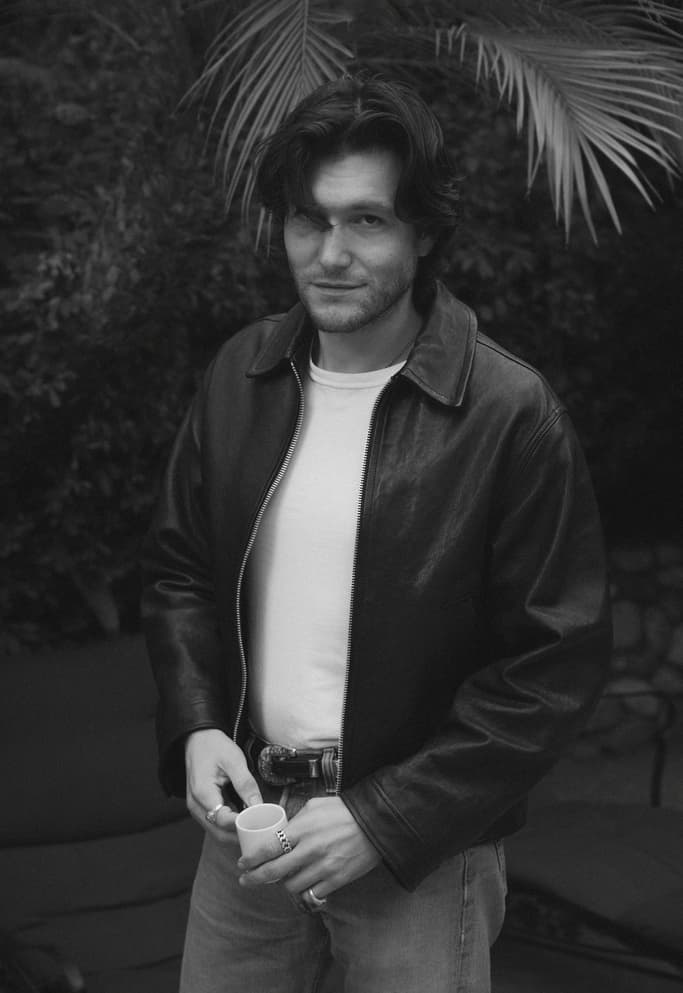
Something Very Bad Is Going to Happen plays rather cunningly with the idea that something is “off” long before we understand what, something unfamiliar that borders on terrifying and thrilling. When you first read the script, what unsettled you the most?
What unsettled me the most was Jules himself and what he experienced – his childhood and particularly his encounter with the “sorry man.” Even if it’s not clear what happened, one thing is certain: Jules saw something no one, let alone a child, should ever see.
Were there moments on set where the atmosphere genuinely got under your skin?
Yes, for sure. Living the scenes in the gorgeous maze-like house built by Dick Lunn, with actual childhood photos hanging on the walls, you do get fully immersed in that world. And especially later on – without spoiling too much – when you really go there emotionally, it doesn’t just stay on set. There were definitely days when we got deep enough that you feel it in your body afterwards. You carry it home a little.
How would you describe the show to someone who’s yet to watch it?
It’s terrifying AF, but also it’s more than that. It’s a psychological horror about relationships, denial, honesty, intimacy, and how generational trauma quietly shapes people. It’s also about that fear of choosing the wrong person. It’s very human, scary, and sometimes really funny.
Your character, Jules, is part of this deeply unnerving family dynamic. How did you approach playing someone who exists quite finely in that tension between normalcy and menace?
For me, it was understanding Jules’ wounds and his defence mechanisms. I didn’t want to play “menace.” I wanted to play protection, distrust, survival. He can look cold or intense on the outside, but that’s the shell. The tension comes from underneath, from how hard he’s trying to stay in control, keep everyone safe, and keep things contained.
There are a lot of shocking moments in which Jules is involved. What do you think viewers will be most surprised by?
Without giving anything away, I think people will be surprised by how much is underneath Jules. He’s like an iceberg. On the surface, he might be perceived as cold and off-putting, but after you earn his trust, he lets you see more of him, and when something is truly at stake, he fights for it. He’s truly honest with the people he cares about, and I think viewers will be surprised by what’s driving him emotionally.
What references or other works did you take inspiration from or channel to nail this character?
I live and breathe art and movies, and of course, I gain endless inspiration from it. But when I get a job, I try not to lock into one specific reference. I don’t want to imitate, not even unconsciously. I try to build characters from within. I did watch Funny Games by Michael Haneke, but more than that, I went toward research – books, documentaries, real people and real stories of trauma. I like inspiration that exists before I “see” the character in my head, if that makes sense.
There’s a sense that everyone in the Cunningham family knows more than they’re letting on. Did you build a backstory for Jules beyond the script?
Fortunately, Haley [Z. Boston] did give us a lot of details and coordinates to ground and locate the character within myself. It made the relationships between the family members so rich. Still, I need to invent things beyond what the script gives me, and I try to go far with it. I built my own story around Jules on top of the already very good foundation Haley laid down: a very clear inner life, what he’s protecting, what he’s ashamed of, what he refuses to look at, and most importantly, why.
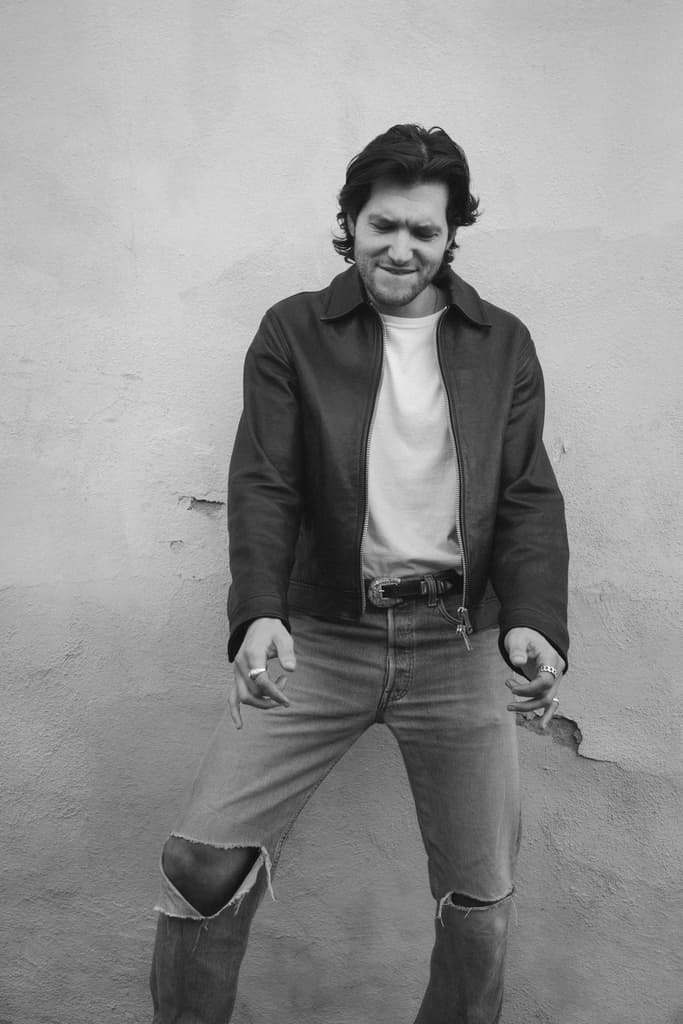
In watching the show, it’s hard to know for sure or identify where Jules sits morally. He’s surrounded by all these points of contention that can make him complicit, conflicted or oblivious. Where do you think he sits morally?
That’s what’s interesting about him. Morally, I do think Jules is a good guy. He wants to protect his family, and he wants to do the right thing. But he has strong defence mechanisms, and before you understand him, he can read as cold, scary, and even menacing. That’s the shell. Underneath, he’s trying to survive – be a good dad, be a good son, be a good partner, and be human. He can’t let what he saw in his childhood happen again.
Was there any part of Jules that you recognised in yourself? And vice versa.
Yes. I recognise that agility, reading the room instantly, being on guard, and having a lot of different thoughts at the same time. Also, his need to stay in control. And vice versa. I get the sense that if I were to meet Jules at a bar, he would relate a lot to my being the oldest brother in the family, my having to grow up at an early age, and how I left home. I really wanted to give Jules humanity, despite his flaws and missteps. Even when he’s intense, I see someone trying to survive and protect himself and the people he loves.
The series explores paranoia and intuition both intricately and subtly. In real life, do you trust your instincts or are you more rational?
I’m both. I really try to listen to my instincts, and I find that to be one of the most important tools I have as an artist. But I also check in with myself a lot, because sometimes fear can feel like intuition. So I listen to my instincts first, and then I try to verify.
Talk to me about your working relationship with Haley Z. Boston. How did she support you in the production of this show and honing in Jules’ character?
Haley is incredibly talented. She wrote a rare script that is also deeply personal. She created a Jules who was so unique and so multi-layered, and so damn right for me. When she cast me, I told her I felt like she wrote the role specifically for me, as a person and as an actor. So much of it resonated with me. During filming, I asked her many questions, and I felt like she empowered me to explore and improvise. I felt really inspired working with her.
What was the collaborative process like with your fellow co-stars? I’d love to know more about that dynamic and what it was like building that strange, almost claustrophobic family unit.
Everyone in this cast was such a treat to work with. I’m so grateful. Really, really good eggs, and all so freaking talented on top of it. We talked a lot about the family dynamics and then trusted the scenes. It’s the kind of set where listening becomes everything, because the tension lives in what isn’t said. Camila Morrone is carrying the show so beautifully, and what was so interesting is that her character, Rachel, is entering this family from the outside, so that dynamic was already built into the work. Adam DiMarco, who plays my brother, Nicky, is such a talented, good-hearted guy, and working with him on that complicated sibling dynamic felt very safe and emotional, especially because we became really good friends, which just added depth to it. Karla Crome, who plays my wife, Nell, is so precise, so in the moment, so funny, and we immediately had chemistry. She was also show-running another show she wrote (called Possession, coming out soon on Sky) while filming this one, which is mind-blowing. Gus Birney, who plays Portia, my sister, our rising star, what a talent. The character she created is so unique and so different from who she is in real life. Sawyer Fraser, who played my son, Jude, is such a wonderful actor. And then the legendary parents, Jennifer Jason Leigh and Ted Levine. And Zlatko Burić and others. Really, what a cast.
The show is also executive-produced by The Duffer Brothers. Were you a fan of their work before? And how did their influence change the tone or scale of what you expected going in?
I was so honoured, and of course, I’m a fan of those two. When the Duffer Brothers are involved, you expect the cream of the crop in every department, and that’s what we got. They brought the best people together, and the fact that they produced the show raised the bar and level of excitement for everyone.
You’ve played characters across very different worlds, from Unorthodox to this. Has this show changed your approach to the projects you’d like to work on in the future?
It sharpened it. I want projects where the writing is personal and risky, where the genre is a vehicle for something deeply human. This reminded me that when the writing is honest, people feel it. Unorthodox is a deeply personal story which provides entry points for people from all walks of life, despite being about a very closed-off community, and it’s the same thing with SVB. Not everyone is a fan of horror, but because the writing is so personal, I think it’s resonating with a wider audience. The personal becomes universal, regardless of genre – that’s the essence of what I want to chase.
Photography
Yotam ShwartzStyling
Max Goldman
![Picture of “[After Boots, People Said:] ‘You’re So Nice, I Can’t Believe That You Play Such A Freaky Sociopath’”: Angus O’Brien Is Marching On](/_next/image?url=https%3A%2F%2Fadmin.manabouttown.tv%2Fwp-content%2Fuploads%2F2026%2F05%2FANGUS-OBRIEN-hero-image-768x341.jpg&w=3840&q=85&dpl=dpl_s7wFmvZo5YcTNCjx5sb4PUUzKfcj)
![Picture of “Anyone Who Knows Me Or Knew Me When I Was Younger Would Be Laughing At The Idea [Of Me Being A Fashion Campaign Face]”: Corey Mylchreest On Becoming A Fully-Fledged Leading Man](/_next/image?url=https%3A%2F%2Fadmin.manabouttown.tv%2Fwp-content%2Fuploads%2F2026%2F04%2Fg.jpg&w=3840&q=85&dpl=dpl_s7wFmvZo5YcTNCjx5sb4PUUzKfcj)