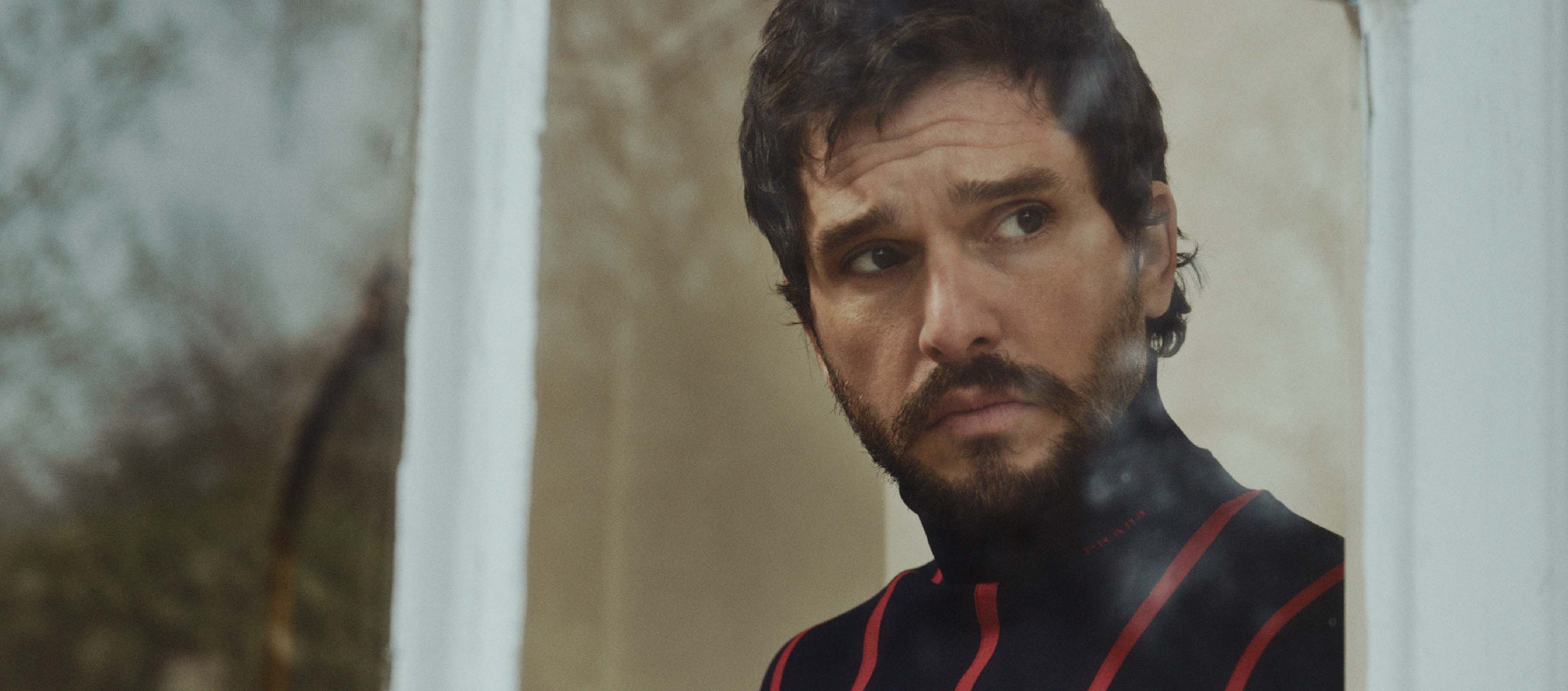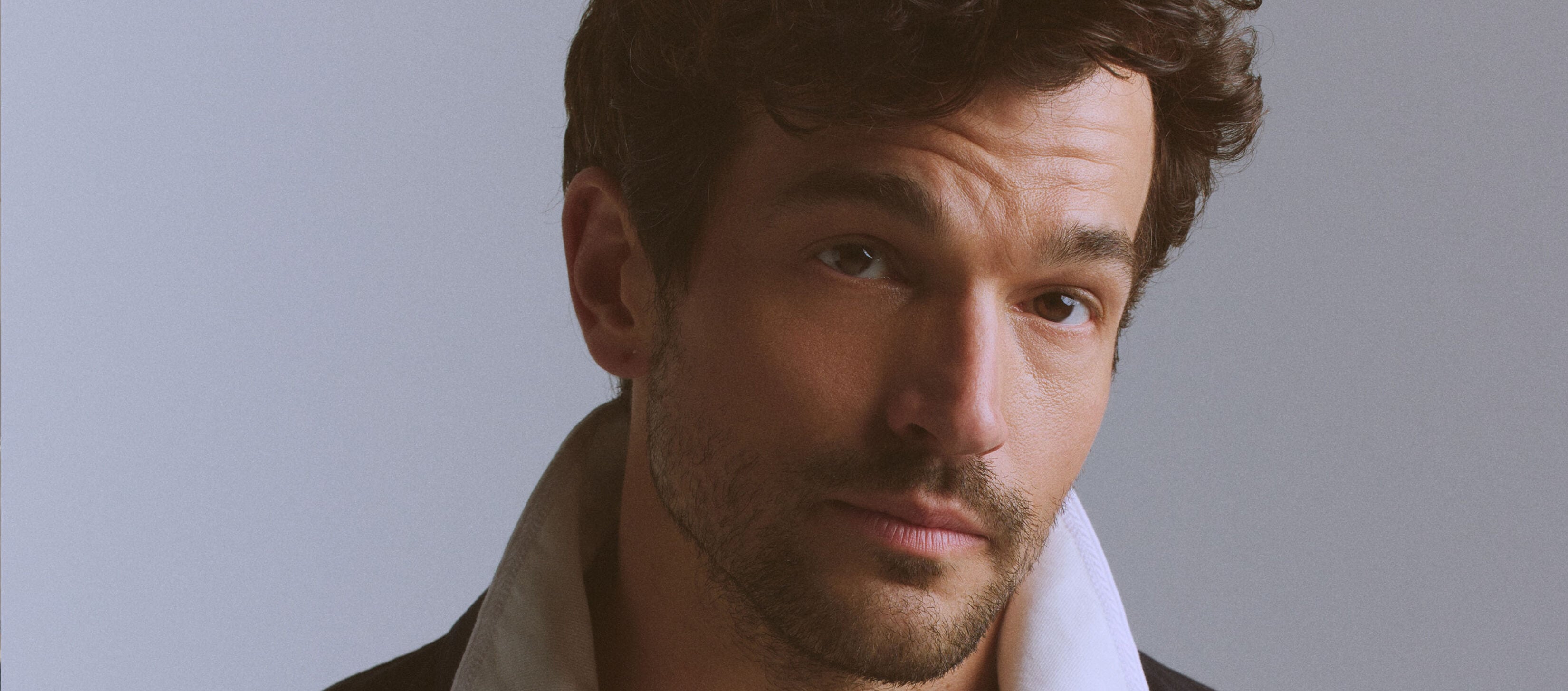


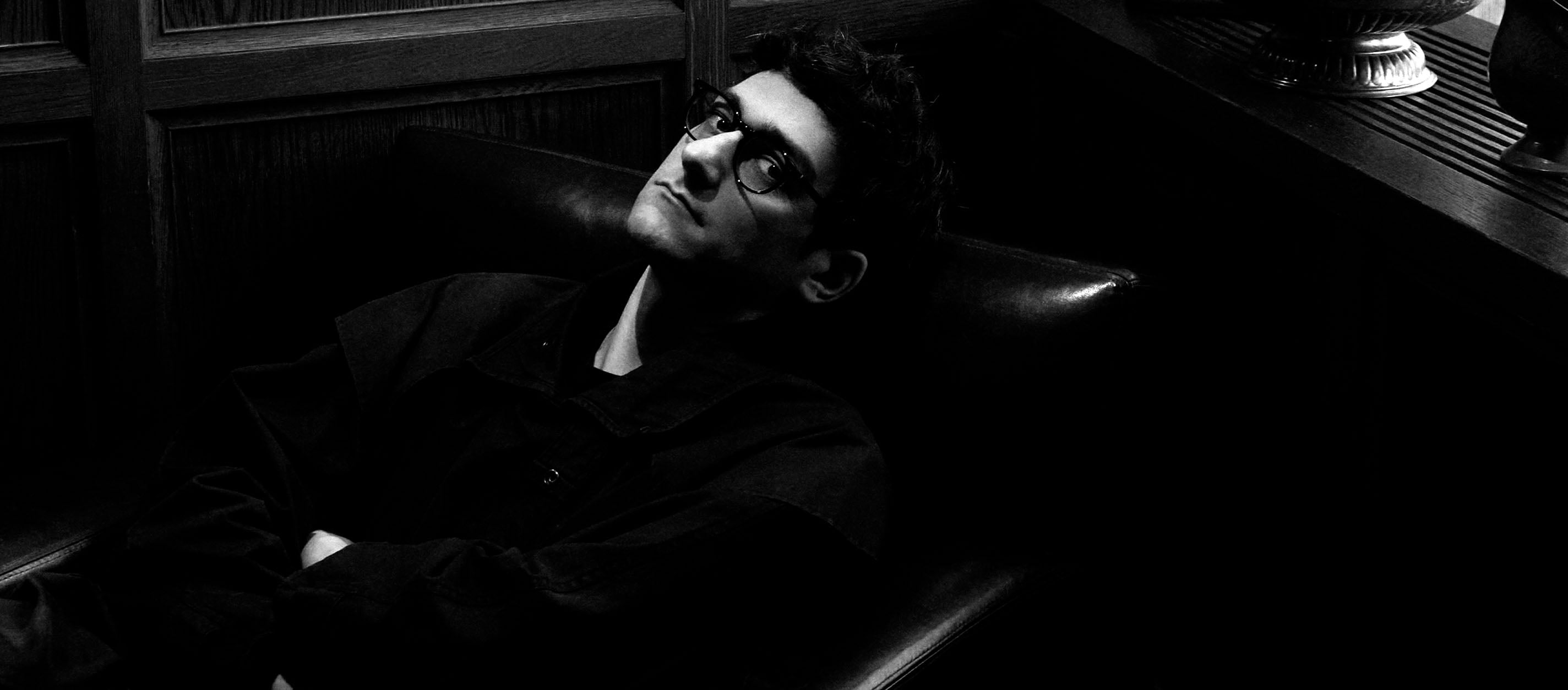
After the culture-shaping superproducer helped the likes of Dua Lipa and Caroline Polachek realise their pop visions, he made space to orbit his own – over 15 years into his career.
“It was almost like a baby that had to be born,” Danny L Harle says of his February debut album, Cerulean. “I feel like I’m mature enough musically [now] to make what I consider to be my first proper statement. A statement of vision and intent.” The resulting LP is grounded in ’00s-driven trance-pop, but loaded with nutrients from his omnivorous musical diet spanning centuries and the genre spectrum. It sets out to produce the paradoxical Harle-termed quality “melancholic-euphoria” – “the feeling that I get that unites music from 400 years ago to that of the late ’90s or to contemporary classical music.” And it comes with an astral backdrop, an underpinning desire to engineer “alien beauty.”
Cerulean is the 36-year-old London producer’s official debut. However, he has fathered a previous album-sized project in 2021’s Harlecore – a conceptual work rather than an identity declaration that was divided into sections, each embodying the different rooms and vibrations of a ’90s rave. He has also helped birth a movement in itself – hyperpop – alongside AG Cook and his collective PC Music, the reverberations of which are infinite across the corridors of the pop universe today. In the years since, Harle himself has remained very much on the genre’s axis, latterly helping to bring some veritable pop royal babies into the world, not least executive-producing Dua Lipa’s 2024 third LP Radical Optimism.
However, the wealth and breadth of Harle’s work to date is why the need for an official debut album of his own became more urgent. Prior to its creation, “I felt like I was expressing myself in a fragmented way.” He wanted to have a body of work that encapsulated concisely what he was about, to share with audiences and collaborators alike. “I would be playing [collaborators] bits of my music, bits of other music, saying, ‘Oh, this is good.’ And then I realised that’s what your own music should be saying: ‘This is what I think is good.’”
If there’s one thing palpable from chatting to Harle, for 45 minutes on a Tuesday morning at London’s EDITION hotel, it’s his conviction in what he thinks works. “I’ve always just known what I like,” he says. That directional clarity has been a blessing and a curse at different points in his life. “I spent a lot of time feeling quite alienated and like an outsider in the world. I think the people who know me say that I’m unable to code switch, and I am very much myself in every environment, which has been to a fault sometimes.” It hindered his enjoyment of his school days, as well as his time studying classical music at Goldsmiths University and composition at Guildhall School of Music and Drama. “I never really got on at institutions, but they did serve a purpose. I’ve always enjoyed life the most when I can just choose what I do.”
That decisiveness has bolstered his aptitude for producing for pop’s top flight. He often finds that his favourite tracks in the studio resonate least with an artist’s audience upon release. So “I can actually use that intuition in the inverse and sometimes be like, ‘Okay, this is my favourite [song] so it shouldn’t be a single.’” It also aids him in mastering the near-impossible feat of being uninfluenced by the world around him when it comes to the subjectivities in his own musical consumption.
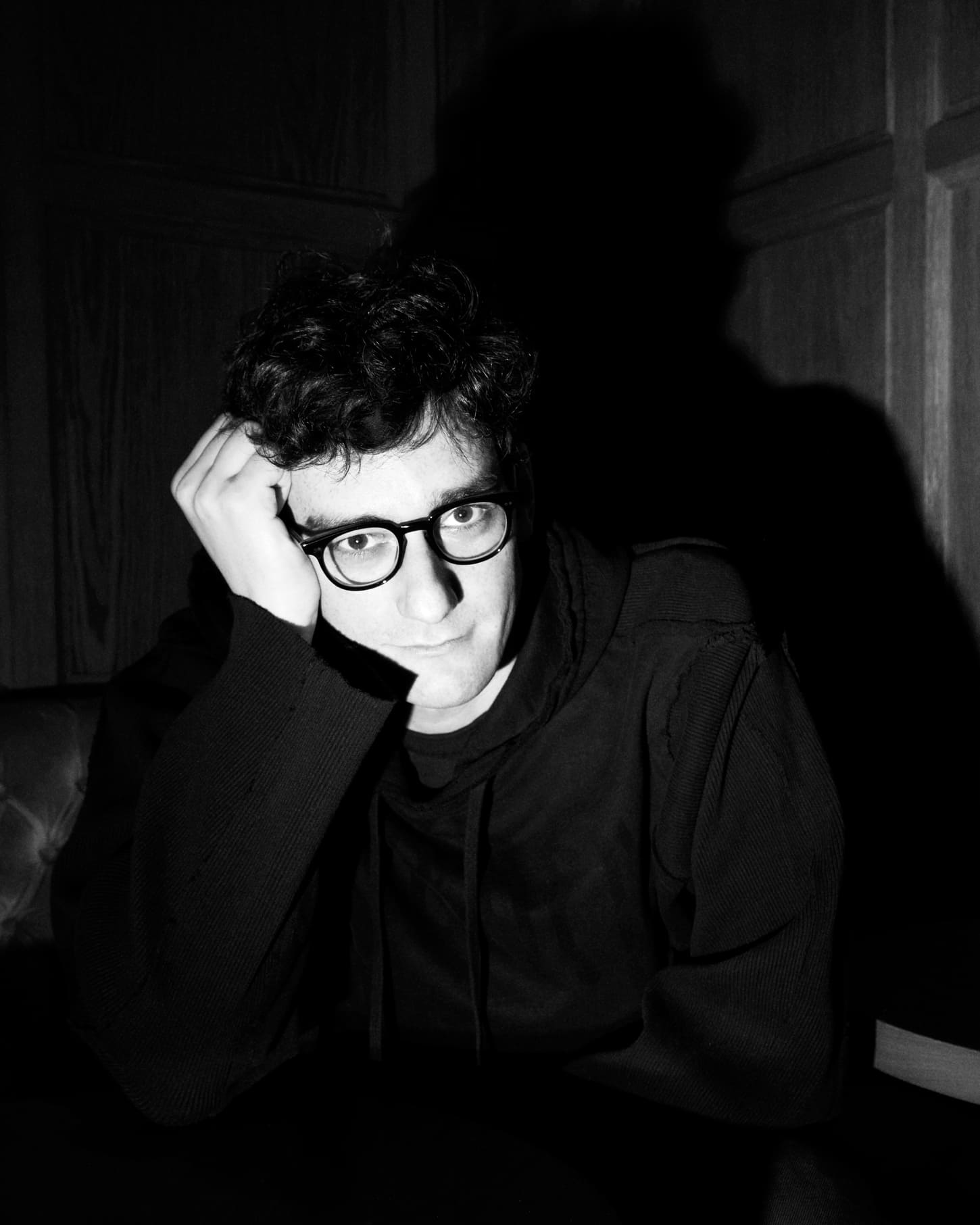
Harle’s the picture of an esoteric music nerd, with an eclecticism stemming from his dad, saxophonist John Harle OBE (Paul McCartney, Elvis Costello). “He showed me so many different kinds of music. He’d take me to free improvised jazz concerts, opera, all of these different things.” Today, Danny uses YouTube rather than streaming services to do virtual crate-digging as “it’s often [an artist’s] more experimental side projects that [are on there].” However, any risk of him leaning into haughtiness – although he would be qualified more than most – is rendered impossible by his lack of conception of a guilty pleasure. His disregard for a song or artist’s standing in the cultural imagination means that while some term Eiffel 65’s “Blue (Da Ba Dee)” as “eurotrash”, to Danny, it’s an artefact to be marvelled at. “I have no cultural baggage listening to music, no sense of things being cringe or high art or low art.”
His now-seven-year-old daughter, Nico, has even clicked onto his affinity for “Blue”. A few years ago, a rickshaw passed them in Central London, the track blaring from its speakers. “She said, ‘Daddy, did you write that?’ And I was like, ‘I’m very proud that you asked that question,’ because even at that age, she could recognise my world of music,” he laughs.
Perhaps that astute moment helped make Harle inclined to welcome her and her three-year-old sister Cosima into the studio during Cerulean’s creation. “Island (da da da)” – an accordion-laden trance number – features Nico’s vocals. Cosima can be heard, with wonderment, shouting “It’s music!” on track nine, “O Now Am I Truly Lost”. Nico had a proven track record following contributions to Caroline Polachek’s “Bunny Is a Rider”, named Pitchfork’s best song of 2021. “She’s got quite a lot of catalogue now,” Harle grins.
Polachek was one of several of Harle’s previous collaborators who would return their services when it came to Cerulean. Lipa and fellow British artists Pinkpantheress and MNEK are also among the LP’s seven credited features. It’s helpful he had a weighty contact book to draw from, as there were many musical checkpoints to pass. “I realised that each song should be a gesture,” he explains of the record’s diversity. “And if another song is making the same gesture, whether it be genre or melodic style or using a certain synth, then there’s only room for one.” Lead single “Starlight” – which Harle says marries his love of composer Monteverdi with ’90s eurodance and ’00s trance – formed part of sessions for Pinkpantheress’s own album. “But then there was something that was slightly too Elizabethan about it,” Harle explains,“which is kind of the scale. If it gets to a certain amount of Elizabethan, then it’s for me.”
Track 10, “Two Hearts” – a lustrous dance-pop melodrama – bears origins before Harle and Lipa first shared the studio for Radical Optimism. “I wrote the instrumental as soon as I found out we were working together. I thought, ‘This is the song I want to hear Dua on.’ It didn’t end up feeling aligned with Radical Optimism’s orientation. “She had a very clear vision for that album.” However, she returned to the song in a separate session. “I would quite confidently say that she chose to revisit it knowing it wasn’t for her [album], out of a spirit of generosity, which is particularly meaningful considering how valuable her time is.” French pop futurist Oklou, another of Cerulean’s guest stars, said in a New York Times profile that Harle smiles constantly when in the studio.
Does the creative process ever cause him pain? “It is incredibly painful,” he admits. “It’s not a thing I like to talk about, because it sounds like I’m asking for sympathy or that I feel like I’m complaining, because it’s a privilege to be able to make music. But if your standards are high and you spend a lot of time making something and then you realise after you’ve made it that it’s good, but it’s not good enough, it can be quite heartbreaking.”
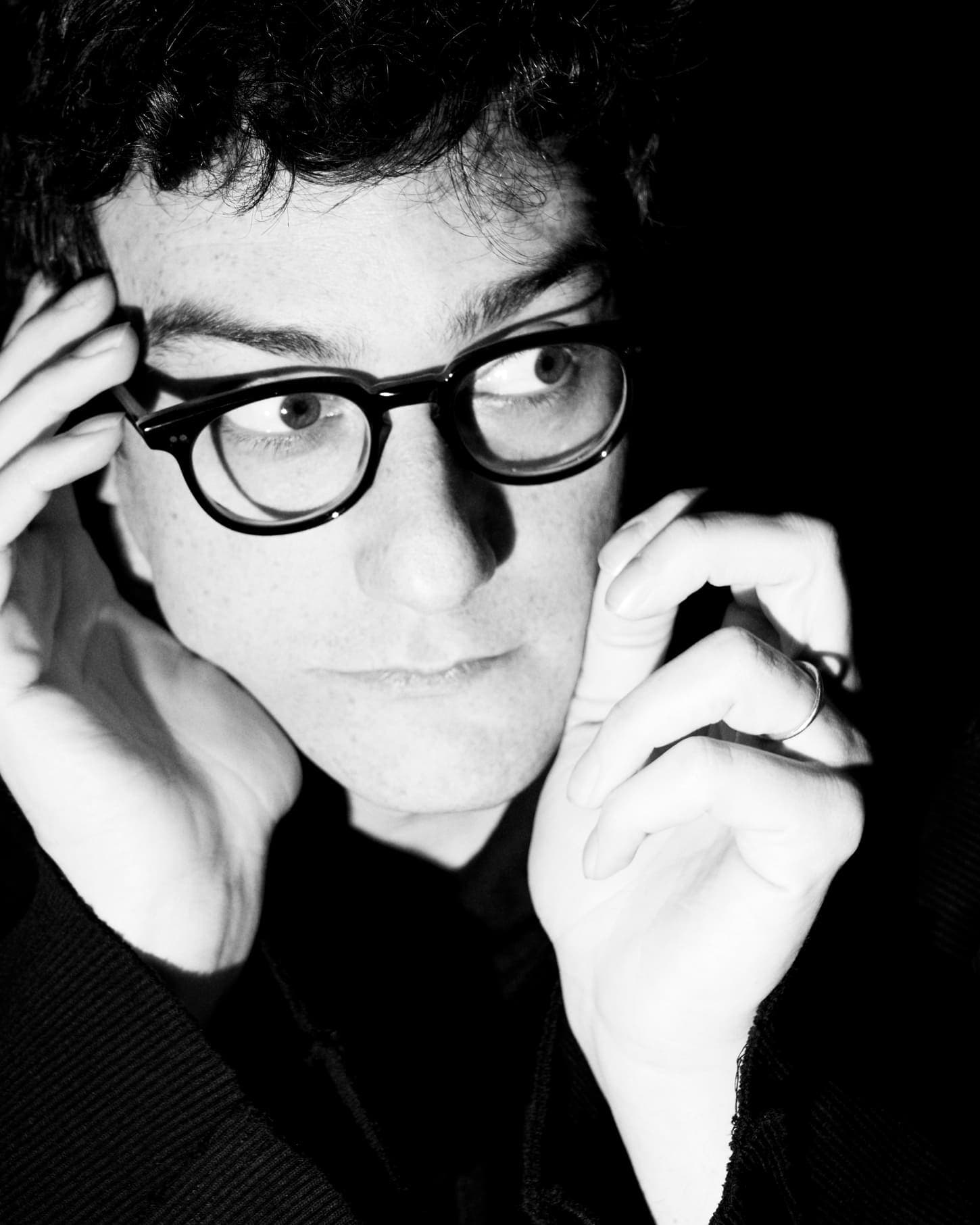
Thankfully, the fortunes of his work following release are less likely to penetrate his psyche. Hyperpop was, in its early days, polarising. Its plastic sonics and dialogue with uber-commercial pop were perceived by some as a sharp take on consumerism, and by others as a pastiche of music that was already considered disposable. However, with Harle’s aforementioned conviction in tow, detractors were unable to throw him off course. His understanding of the “glacial” way culture moves meant that, “It’s never something I felt bad about. The very fact that me and AG used to DJ this music that would clear a dancefloor, and then now there’s club nights that are based around it – it happens because things just get absorbed a bit slowly.” The last thing he would ever want to attract is indifference. “I think a repulsion response is actually more that people hate that they love it. It’s somebody hating the fact that it’s making them feel something that they feel is off-brand for them.” Does he feel like time has been kind to the genre? “I can’t really say, because I’m so unaware of any discourse. I always have been because, forgive me, I don’t read any journalism,” he smiles. “I’ve always just interacted with artists, and artists are always very open to things.”
Rest assured, he didn’t read any of Cerulean’s reviews, which lacked consensus. “I’ve been told about a few, and it’s just the same thing that is always happening.” He’ll remain unperturbed as the project journeys through whichever cosmic pathway it belongs in. Indeed, there are plans to expand on the original release, as he hints at surplus material lingering on his hard drive. “I was so happy with all of it, so there is still room for it to be elaborated on.” A deluxe? “More”, he says, a coy full stop audible.
When he signed with XL Recordings to release Cerulean, they “encouragingly” asked him: “‘What does success look like to you?’” His response was frilless – “‘To find all of the people that want to listen to this, play it to them and make sure they’ve heard it.’” As he orbits Cerulean’s release – a solo tour now ticked off and its “elaboration” somewhere in the distance – has the debut album experience amounted to a feeling of success at its most potent? A build upon the high of having a hand in a blockbuster pop album like Lipa’s or configuring a new genre? “It is all grasping at the same thing,” he says. “But just from different angles and different lenses. I’ve always had a larger-scale plan of what I want to make over my lifespan, and I’ve got a few more statements to make, a few more angles to explore.” In simple terms, “I’m just a dog chasing cars.”
Cerulean is out now via XL Recordings
Photography
James AnastasiSpecial Thanks
The London EDITION
![Picture of “[After Boots, People Said:] ‘You’re So Nice, I Can’t Believe That You Play Such A Freaky Sociopath’”: Angus O’Brien Is Marching On](/_next/image?url=https%3A%2F%2Fadmin.manabouttown.tv%2Fwp-content%2Fuploads%2F2026%2F05%2FANGUS-OBRIEN-hero-image-768x341.jpg&w=3840&q=85&dpl=dpl_s7wFmvZo5YcTNCjx5sb4PUUzKfcj)
![Picture of “Anyone Who Knows Me Or Knew Me When I Was Younger Would Be Laughing At The Idea [Of Me Being A Fashion Campaign Face]”: Corey Mylchreest On Becoming A Fully-Fledged Leading Man](/_next/image?url=https%3A%2F%2Fadmin.manabouttown.tv%2Fwp-content%2Fuploads%2F2026%2F04%2Fg.jpg&w=3840&q=85&dpl=dpl_s7wFmvZo5YcTNCjx5sb4PUUzKfcj)